

Overview
In this blog, Knights Plumbing, LLC. explains how common water purification methods work, what influences the treatment your home may need, and why understanding your water is an important first step.
Highlights
- What can be present in household water
- How water treatment works
- Water softening
- How your water source affects treatment
- Testing your water
Introduction
Water purification is quite a broad term. A system that helps with sediment or discoloration may work differently from one intended to improve taste or address hard water. That distinction matters when you’re trying to understand what a particular system will actually do once it’s installed in your home.
Rather than starting with a specific piece of equipment, it helps to start with the water itself. What characteristics are you trying to change, and which treatment method serves that purpose?
Understanding these differences can help you evaluate your water treatment options and choose a system designed for the conditions in your home.
What Can Be Present in Your Household Water?
Household water can have different characteristics depending on its source, local conditions, treatment before it reaches your property, and your plumbing system. Some concerns are noticeable because they affect appearance, taste, or smell, while others may require appropriate testing to identify.
Depending on the home and water supply, water-quality concerns can include:
- Sediment
- Rust particles
- Dissolved minerals
- Chlorine taste or odor
- Unpleasant smells
- Cloudiness or discoloration
- Hard water
- Acidic or alkaline water
- Microorganisms
These concerns don’t necessarily call for the same treatment. Capturing suspended particles is a different task from addressing hardness or treating a microbial concern. Before choosing a water purification system, it helps to identify the characteristics you want to address and understand which treatment methods are intended for them.
How Do Different Water Treatment Methods Work?
Water treatment systems use different processes to address different characteristics in household water. Some physically capture particles, while others use carbon media, membranes, or ultraviolet light for more specific treatment purposes. The method used influences what the system is designed to address and where that treatment may fit within a larger setup.
These processes can also work together. A water purification system may include multiple treatment stages, with each component performing a particular function as water moves through the system.
Understanding these basic differences can help you make sense of how filtration, activated carbon, reverse osmosis, and microbial treatment serve distinct purposes within household water treatment.
How Does Water Filtration Work?
Water filtration works by passing water through material designed to capture particles as the water moves through it. Certain filters, for example, can separate sediment and other suspended material from the water before it continues through the plumbing or another stage of treatment. Because filter materials and designs vary, different filters serve different purposes.
In a multistage setup, filtration can also prepare water for the treatment that follows. An initial filter might capture sediment before the water reaches another component designed to address a separate concern. Doing so helps protect downstream treatment components from buildup that may reduce their effectiveness or shorten their service life.
What Is Activated Carbon Filtration Used For?
Taste and odor are common reasons activated carbon is used in household water treatment. Carbon filtration is also frequently used when chlorine in treated water contributes to an undesirable taste or smell.
As water passes through activated carbon, certain substances adhere to its surface through a process called adsorption. This gives carbon media a different function from a sediment filter, which is designed to capture suspended particles. The distinction is useful when comparing systems because two products described as “filters” may be designed for very different water-quality concerns.
How Does Reverse Osmosis Treat Water?
Reverse osmosis uses water pressure to force water through a semipermeable membrane with extremely small pores. Water molecules can pass through the membrane, while many dissolved substances are rejected and carried away in a separate waste stream. This process allows RO to address contaminants that basic sediment filtration can’t simply strain from the water.
Depending on the membrane and system design, reverse osmosis can reduce dissolved salts and minerals, including sodium and chloride, as well as substances such as lead, arsenic, nitrate, fluoride, and certain other dissolved contaminants. RO systems are also commonly used to lower total dissolved solids (TDS), which is a broad measurement of dissolved material in water.
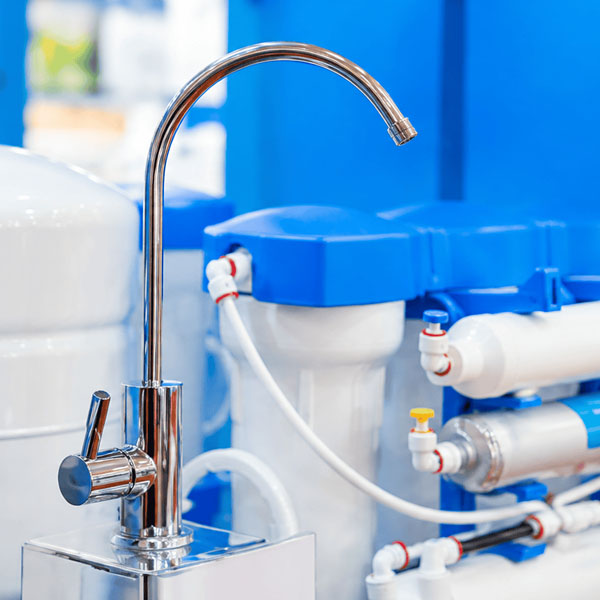
The membrane isn’t necessarily the only component involved. Many RO systems use a sediment prefilter to remove particles that could clog or foul the membrane and a carbon prefilter to reduce chlorine, which can damage certain RO membranes. Some systems also include a postfilter to address taste and odor before treated water reaches the faucet. Each stage serves a different purpose, so the system’s specific components determine which substances it can effectively target.
How Can Water Treatment Address Microorganisms?
Ultraviolet treatment addresses microbial concerns without physically filtering organisms from the water. UV systems expose passing water to ultraviolet light that disrupts susceptible microorganisms, preventing them from reproducing.
UV treatment can address bacteria, viruses, and certain protozoa, but it doesn’t remove sediment, minerals, or chemical contaminants. Because sediment and cloudiness can interfere with UV light, pretreatment may be necessary to help the system work effectively.
How Can Water Treatment Correct pH?
Water pH indicates how acidic or alkaline the water is. Water with a low pH is acidic and can contribute to corrosion of metal plumbing and fixtures. One common treatment is an acid-neutralizing filter, which passes water through a medium such as calcite. As the medium dissolves, it raises the water’s pH and reduces its acidity.
More acidic water may require a chemical feed system that introduces a neutralizing substance, such as soda ash, in a controlled amount. Water with an excessively high pH requires a different approach and may be treated through controlled acid injection or another method suited to the water chemistry.
Because changing pH can affect other characteristics of the water, including hardness and mineral content, testing helps determine both whether correction is necessary and which treatment method is appropriate.
How Is Water Softening Different From Purification?
Water softening and water purification aren’t interchangeable terms. Hard water is associated primarily with dissolved calcium and magnesium. A conventional water softener reduces these hardness minerals through a process called ion exchange rather than physically filtering them from the water.
During ion exchange, hard water passes through a tank containing resin beads charged with sodium or potassium ions. The resin attracts and holds calcium and magnesium ions, releasing sodium or potassium ions into the water in their place. Once the resin becomes saturated with hardness minerals, the system regenerates by flushing it with a concentrated salt solution. This removes the accumulated calcium and magnesium and recharges the resin so the softening cycle can continue.
Because this process specifically targets water hardness, softening serves a different purpose from treatments designed to reduce sediment, dissolved contaminants, or substances that affect taste and odor. Mineral buildup on fixtures, scaling, and difficulty producing a good lather can indicate hard water and point toward softening as the relevant treatment objective.
Why Does Your Water Source Affect Treatment?
Where your water comes from provides useful context when considering treatment. Municipal water typically undergoes treatment before it enters the distribution system, while private well owners are responsible for monitoring their own water supply. Those differences can influence the water-quality concerns homeowners investigate.
Conditions can also vary among homes using the same general type of water source. Local geology, the distribution system, private plumbing